Dave Youngs – Head of Classic at Peter James Insurance and part of the Kingfisher Motorsport team – takes to the navigator’s seat in the TR7 V8 “Wedgie Warrior” for the Land’s End Trial, tackling 250 miles of mud, hills and midnight decision-making in one of motorsport’s toughest surviving challenges.
One of the oldest forms of motorsport, and one that began almost as soon as the first cars turned a wheel, the sporting trial has always been less about speed and more about survival. This test of endurance for both crew and machine evolved from the need to prove the motorcycle, and later the motor car, as viable modes of transport.
In the early years, motorists simply wanted to know whether their machines could make it from one place to another over roads that were barely roads at all. Hills, mud, rocks, and unreliable engineering defined the challenge, and from that grew a discipline that still exists today, largely unchanged in spirit.
The Motor Cycling Club, a partner of our sister insurance brand Kingfisher Motorsport, has been at the centre of it since 1901, quietly preserving a form of motorsport that values control, judgement, and mechanical sympathy above outright pace. The Land’s End Trial remains one of its defining events. Once starting in London and heading to Lands’ End, the modern-day route now traverses Somerset from the start in Bridgwater, through Devon, and into Cornwall, linking a series of sections that have tested competitors for over a century.
In the 1930s, manufacturers arrived with full works teams, keen to prove their cars could endure the same terrain as their rivals. Today, the machinery is just as varied, but the motivation is much the same – only now it’s driven by passion, persistence, and the occasional questionable decision made somewhere in a forest in the depths of night!
Life in the Wedgie Warrior
From the passenger seat of car 163, a Triumph TR7 V8 known – affectionately and entirely accurately – as the Wedgie Warrior, the Land’s End Trial reveals itself not as a race, but as a long, unfolding story of camaraderie, endurance, engineering skill and confidence in the machine. My role is to navigate between sections, manage time, interpret the route book, and, when necessary, translate it into something resembling calm instruction for my driver, now seasoned ‘trialer’ Wayne Scott. Oh, and spot potential hazards on sections like logs, rocks, boulders and big holes – I think we may have some work to do in that area!
My job was also to look after tyre inflation, as when we approached the bottom of a section, we needed to reduce tyre pressure to help find more grip and then re-inflate them at the top of the section back to road pressures again. To do this quickly, we are equipped with an impressively sized compressor and air tank in the boot, giving us the capabilities of a fuel station forecourt in blowing up tyres in super quick time.

Wayne has been piloting the TR7 V8 alongside Phil Tucker’s famous TR3A (pictured above) for eight years now. As Head of Classic at Peter James, part of Kingfisher Insurance, I see another side of the event too – one that most competitors rarely think about, but rely on completely.
An Adventure Built on Structure
Because while the trial may feel like an adventure, it is underpinned by a surprisingly structured framework implemented by an army of hundreds of superstar volunteers. Between sections, you are on the public highway, bound by the Road Traffic Act, which means proper insurance cover is essential. Through Kingfisher Motorsport, that cover extends to competitors throughout the event, ensuring that as you thread your way through sleeping villages and narrow country lanes in the early hours, you are protected in the same way as any other road user.
On the sections themselves, the environment changes – controlled, marshalled, governed by motorsport regulations – but the same principle applies: the event works because it is carefully managed, responsibly run, and supported by people who understand both the risks and the rewards. It’s something we’re quietly proud of because in today’s increasingly tricky world, our insurance enables this poignant part of motoring history to continue for generations to come.
Evolved, Not Reshaped
Our own car is a perfect example of how the spirit of the sport has evolved without losing its roots. The TR7 began life as a modest 2.0-litre car in Persian Aqua Blue, but now runs a Rover 3.5-litre V8, chosen not for outright speed but for its torque and flexibility – qualities that matter far more when you’re trying to coax a car up a loose, uneven climb in the dead of night. The regulations insist that the silhouette and basic layout remain recognisable, so from the outside it still looks every inch a TR7, but underneath it has been carefully adapted for the demands of the trial.

The front suspension is lifted with spacers, the struts reinforced, the anti-roll bar removed to allow greater articulation, and the springs reworked to provide extra height without upsetting the car’s natural balance.
At the rear, air suspension allows us to adjust ride height as conditions demand, while uprated components and modified geometry help keep everything under control when the terrain does its best to shake it apart. Protection is just as important as performance: a skid pan guards the sump, the exhaust is routed high through the rear bumper, and the front end is strong enough to support the car’s weight if recovery becomes necessary.
The tyres, tall and narrow with generous sidewalls, are chosen not for grip in the conventional sense, but for their ability to conform to whatever surface lies beneath them. It is, in every sense, a car built for endurance and strength rather than accuracy and speed, although it manages to always thrill the crowds with its fantastic V8 roar as it bursts through the top of the section to greet the cheering spectators and fellow competitors.
Into the Night
Before all of my fun on the trial, though, the first challenge is to get through the Bank Holiday Easter traffic to get down to Devon to meet Wayne with the car. Upon arrival, I receive a crash course in tyre deflation and inflation, including where to find the tools for the important and sometimes frequent job of changing wheels, and the crucial packing of snacks, route books, and other essentials before we retire for a nap and dinner.
Later that evening, we arrive at the trial, which begins, as it always does, with quiet formality. After scrutineering, which consists of a check that all systems are working in the car, no regulations are being broken, and that we have extinguishers and spill kits on board, it is a compulsory one-hour stop where eggs, chips and beans are on offer and friendships from last year are reignited.

Let The Trial Commence
One of the great joys of the Land’s End Trial is the sheer variety of machinery that lines up at the start. It’s one of the few events where a pre-war Austin Seven might find itself queuing behind a modern hot hatch, while somewhere further up the road, a three-wheeler or a well-used trials special is disappearing into the darkness. The field spans more than a century of motoring, and somehow it all works.
That diversity is carefully organised through the class system. Broadly speaking, cars are grouped by age and type, from the earliest vintage machines through to post-war classics and more modern production cars, with additional classes for heavily modified vehicles, front-wheel drive and purpose-built trials specials. Each class has slightly different rules – some will face restarts on sections where others won’t, some are given preferential start lines, and tyre or technical restrictions can vary depending on the car’s era and capability.
Bound By The Clock
Cars leave Bridgwater at one-minute intervals, each competitor tied to a scheduled time that governs their entire night. We are car 163, so we leave 163 minutes after the event start time. There is no advantage to rushing, and no forgiveness for arriving too early or too late; the event’s discipline is set before the first hill even appears. No sat navs are not allowed; instead, I find myself peering through the beam of a head torch at the road book, which lists our route instructions line by line to guide us to the foot of each epic climb – all in remote locations, deep in forests or high on moors and cliffs. Within a handful of miles, the event’s discipline is reinforced by the handbrake test at Walford’s Gibbet, a deceptively simple check that can end a run before it has properly begun. Beyond that, the roads narrow, the junctions become less obvious, and the sense of stepping away from the ordinary world takes hold.

Some running repairs required, thanks to a log that leapt out in front. Photo courtesy of Zack Averall (Rinus Photography).
Where It Becomes Real
Felons Oak arrives almost without warning, the first observed section of the night, and with it the first real test and I get my first sense of what this sport is all about. I can barely believe the terrain we are skipping, bouncing and crashing over, holes big enough to swallow a Triumph whole and areas so rough that they would defeat the hardiest of modern 4X4 vehicles, but here we are in a rear wheel drive sports car, on road tyres, from the 1970s! Nothing quite prepares you for it – but we need to concentrate.
A restart on a steep gradient, where Wayne needs to straddle the car over the top of a deep gulley, demands precision rather than aggression, and as the car pauses in the box, engine idling, there is a moment where everything else falls away – the navigation, the schedule, the long miles still to come – and the entire event reduces to a single controlled movement. When it works, the relief is immediate and quietly shared; when it doesn’t, the consequences linger. The flag drops and for a moment, the wheels scrabble for grip before purchase is found and we slither and snake our way to a clean finish past the SECTION ENDS board at the top.
At this point, it’s worth explaining the name of the game.
An observed section is judged on one simple principle: forward motion without error. You approach the start line, wait for the marshal’s signal, and then commit. From that point on, you are expected to keep the car moving. Stop, stall, roll backwards beyond the permitted limit, or hit a marker board, and it’s recorded as a failure.
No Grey Areas
There are no partial scores, no grey areas – just clean or fail. The observers stand quietly to one side, watching every movement, noting every hesitation. It’s a very British kind of pressure: calm, understated, and completely unforgiving.
Some sections add another layer with a restart. Partway up the hill, you’re required to stop within a marked box, wait for the signal of a waved flag, and then pull away again cleanly. You have a single attempt, and a limited window – twelve seconds – to get moving without rolling back out of the box or jumping the start. Get it wrong and the section is effectively over.
Alongside the hills, the trial introduces observed tests, which swap gradient for precision and speed. These are small, controlled exercises designed to test accuracy against the clock rather than momentum, and they follow a strict format that quickly becomes familiar.
Precision Under Pressure
You begin stationary with front wheels at Line A. When the signal is given, you floor it, race forward to find an often surprising Line B, ensuring all wheels pass beyond it. Then, without hesitation, you reverse back so that all wheels are fully behind Line B again. Finally, you drive forward once more and stop Line C astride, with the front wheels positioned cleanly across the line.
It sounds straightforward, but under pressure it becomes surprisingly easy to make a mistake – stopping short, rolling too far, clipping a marker, or simply getting the sequence wrong. The whole manoeuvre is timed, and if you fail to complete it correctly, you’re given the maximum penalty time regardless of how quickly you attempted it.
Between these sections and tests, the trial quietly keeps score. Every failure adds marks, every hesitation has a consequence, and by the time you reach the finish, your performance is reflected not in a finishing position alone, but in the colour of the award you’ve earned.
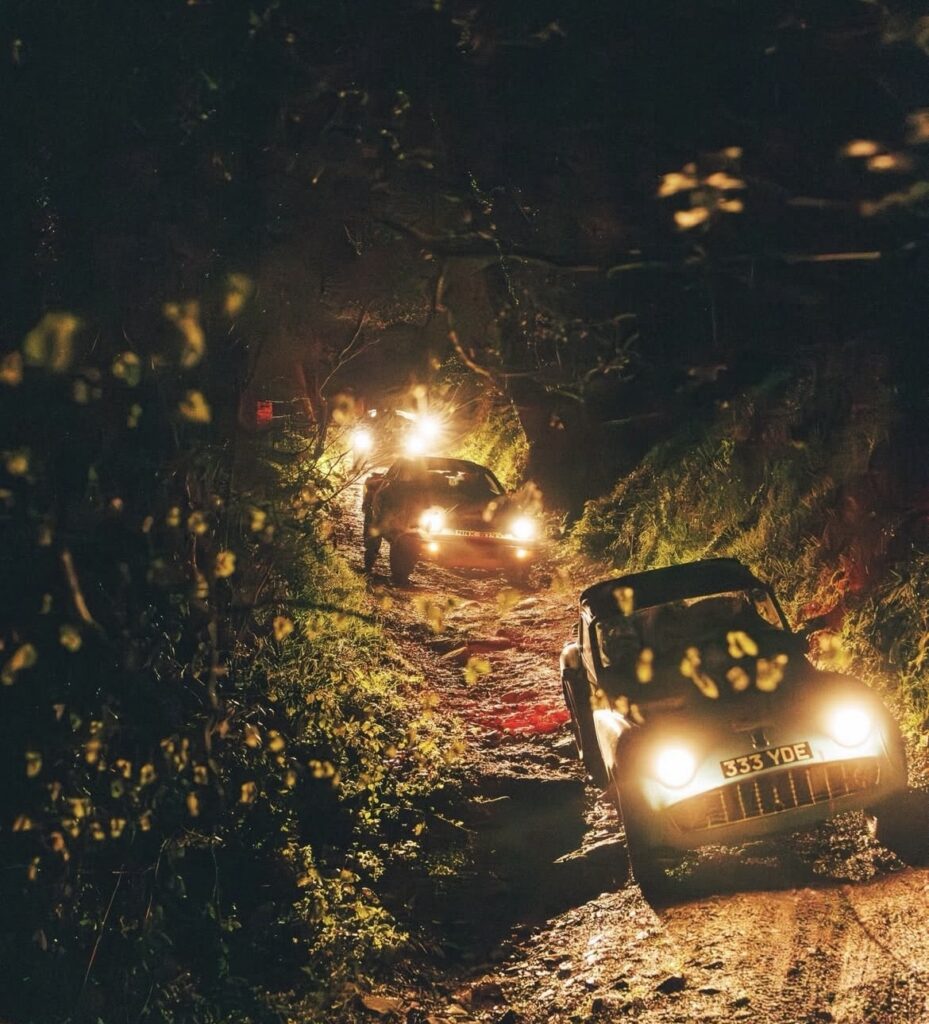
Heading through the night sections. Photo courtesy of Zack Averall (Rinus Photography).
Gold, Silver, Bronze and What It Takes
A Gold medal demands near perfection. You must maintain your schedule, never be early, never be significantly late and complete every observed section cleanly, meeting all the requirements of the route and tests without error.
A Silver allows for a small margin: perhaps a single mistake on a section or test, but still with tight control over timekeeping and overall performance, with a bronze awarding the same, but for those who dropped two hills instead of one. All competitors who make it to the end gain a finisher’s certificate.
And that, perhaps, is what defines the Land’s End Trial more than anything else. It is not about beating someone else to the finish, but about meeting a standard that has remained unchanged for generations – and knowing, when you do, that you have earned it through skill and endurance.
Settling Into the Long Night
From Felons Oak, the route climbs steadily into Exmoor, over Porlock Hill, which was once a section but is now tarmac, threading through villages where quiet zones demand restraint and respect, before opening out onto the moor itself. The darkness, the isolation, and the rhythm of the road begin to settle the car and crew into something approaching flow, but the trial has a habit of interrupting that just as it becomes comfortable.
Beggars Roost, encountered soon after the compulsory halt at Barbrook, is a reminder that there is no gentle progression here, only a sequence of challenges that arrive on their own terms. Barbrook Village Hall serves as a reminder of the English eccentricity of this event and is packed to the rafters with tea and home-baked cakes slaved over by the local parishioners. The welcome is warm, the fuel station opposite remains open all night and the competitors head on up out of the village to one of the trial’s oldest sections, which involves another restart. Clean on both for us so far.

Phil Tucker ascending Blue Hills in his TR3A – trialled for nearly 40 years! Photo courtesy of John Aimee
Where Partnership Matters Most
Through Devon, the event gathers intensity. Sections like Riverton and Sutcombe demand increasing commitment, placing wear and strain on the delicate components of classic and vintage cars. Sutcombe Village is another worthy of note, with villagers braving the cold and dark to serve competitors with tea, coffee and bacon rolls. The welcome is as warm as the China mugs they are served in.
Then, observed tests such as Yollacombe introduce a different kind of pressure, where accuracy and timing replace brute force. Fatigue begins to creep in, not as a sudden weight but as a gradual erosion of sharpness, and it is here that the partnership between driver and passenger becomes most important. Instructions are shorter, conversations are more focused, and the shared understanding of what needs to be done becomes instinctive.
Yet for all the intensity, there is a warmth to the event that is impossible to ignore. At fuel stops and holding controls, competitors gather in small groups, comparing notes, offering advice, lending tools, and sharing the kind of understated humour that only comes from a common experience. It is a reminder that while the trial may be competitive, it is also deeply communal, built on friendships that stretch far beyond a single night’s drive.

Dawn and Disappointment
By the time Cornwall approaches, the landscape begins to change again, and with it the character of the event. The sky starts to lighten at what is possibly the toughest and steepest forest section, Cutliffe Lane. Wayne was wary of this and carried the weight of past failures; this year was no different. The V8 engine was screaming, popping and spitting flames as we desperately scrabbled for the top – but it was not meant to be – maybe next year, said Wayne. The reversing back down, defeated, was every bit as nerve-racking as the climb itself.
Darracott tests nerve as much as traction, a time check on the cliffs high above Bude Bay offers a chance for a photo, and Crackington greets the first light of dawn with a climb that has defeated countless attempts. This year, with only one hill failed, it was all that stood between us and breakfast.

A Test of Nerve
Crackington is a section that lulls you into a false sense of security. You enter it from the depths of a picturesque Cornish valley, complete with spring flowers and a babbling brook. After a water crossing, the section begins and heads uphill. Here, there is plenty of grip, but around the sharp right-hand bend, you are presented with an impossibly steep, muddy ravine, with crowds of spectators willing you on from high above you on either side. The impacts from underneath the car are so violent that it is a challenge to keep your eyes focused forward, and as we snake and slide sideways left and right, Wayne claws at the steering wheel to keep the momentum heading forwards. This year, however, the depth of the mud defeated us, and a tractor gave us an undignified tow out of the section to the sounds of appreciative applause from the assembled crowd. They had enjoyed the committed attempt, but for Wayne, it was the first time he had failed the section this decade, and the disappointment was palpable.
The halt at Wilsey Down offers a brief chance to reset with the comfort of a full cooked breakfast before the final push. Warleggan, high on the moor, demands careful judgement, while the later sections, including Eddy’s Branch Line, bring a more physical challenge that tests both car and crew to their limits. Wayne was not confident of Eddy’s Branch line, but spurred on by the still lingering memory of defeat on Crackington, he spun the wheels off the start line, flicked the car round the starting hairpin and put in the best drive of the trial so far with a faultless and almost balletic climb of both the first and second of the sections here. Pride and confidence were restored.
Blue Hills and The Long Way Home
And then, almost inevitably, the route leads to Blue Hills.

Wheels off the deck on Blue Hills. Photo courtesy of John Aimee
There is something about Blue Hills that transcends its role as just another section. The narrow approach, the gathered throngs of thousands of spectators, the sense of anticipation that builds as each car lines up – it feels like a conclusion, even though there are still miles to go.
Blue Hills 1 demands precision, Blue Hills 2 demands everything else, and as the car climbs for the final time, the entire night and the day that preceded it seem to compress into a single, decisive effort. When it works, the satisfaction is immediate and profound; when it doesn’t, it is accepted with the same quiet understanding that has defined the event from the beginning.
Wayne has had a fifty per cent success rate on Blue Hills 2, but this year, the crowd could be heard over the growls of the Triumph’s V8 as the restart was successfully negotiated and the climb to the stop completed in flamboyant style. I couldn’t help but feel that the entire trial had led to this moment. With so many in the audience clearly regulars who knew the car and its driver from years of competing, Wayne put on a show that thrilled the enthusiastic families and motorsport fans lining the tops of the cliffs, and they responded with shouts of appreciation and applause on the scale you would associate with a football crowd! It was quite a spectacle.
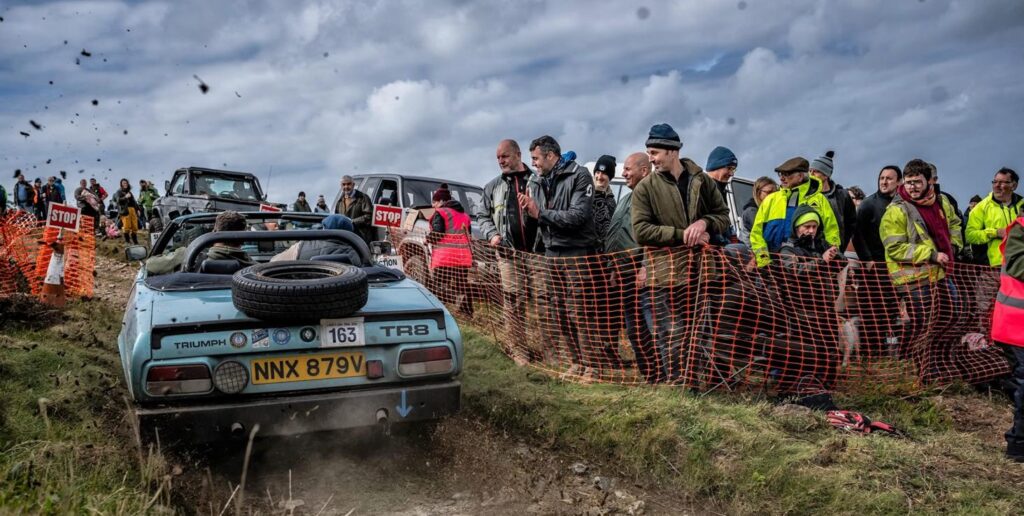
A successful (ish) climb! Photo courtesy of John Aimee.
The run to the finish at Redruth is almost surreal in its normality. After hours of concentration, challenge, and controlled effort, the simple act of driving along an ordinary road feels strangely unfamiliar. At the finish, the formalities are completed, the control card handed in, and the reality of what has just been achieved begins to settle.
Why It Endures
Nearly 250 miles, overnight, across some of the most demanding terrain in the country. A test not just of machinery, but of judgement, patience, and trust. And yet, ask anyone there, and they will tell you the same thing: it is not just the challenge that brings them back, but the people, the shared experience, and the quiet camaraderie among those who understand exactly what it takes.
As the Wedgie Warrior ticks gently as it cools, there is a brief pause – a moment to take it all in – before, without ceremony or celebration, the team heads home with a quiet dignity and the inevitable stories and plans for modifications needed before next year – when it happens all over again.
At Peter James and Kingfisher Motorsport Insurance, we like to have a clear understanding of how our enthusiastic customers use their cars at events, so we can provide the right cover to help you have fun safely. This proved to be an incredible insight into a whole world of ancient motorsport and heritage, and we need to ensure it continues to be enjoyed, cherished, and understood by as many people as possible for another 100 years.
A huge thanks to Wayne Scott in the Wedgie Warrior for the opportunity to be his passenger, to Phil Tucker for his hospitality and guidance, and to Neil Christie and his son Rory, Chris Musselwhite, and Mike Tucker and his daughter Eloise for their company and encouragement. Also, to all the marshals and volunteers within the Motor Cycle Club (MCC) who make this event happen – all heroes.