From Morris Minor panda cars patrolling local neighbourhoods to Rover SD1s pounding motorways, classic British police cars have a special place in our motoring history. But which are the most iconic of all?
Here at Peter James Insurance, we’re prone to a little misty-eyed nostalgia. After hearing how the Morris Minor Owners Club is helping to create a register and historical record of surviving Morris Minor police cars (read on to watch the video from Paul Cowland at this summer’s show), we started debating the greatest British police cars of them all.
You’ll have yours, no doubt, but here’s our list the top 10 classic British police cars.
10. Triumph TR4

The unexpected traffic car
The Triumph TR4 looks more at home on a Sunday B-road blast than outside a police station, but Southend-on-Sea Constabulary found a place for a white example in its 1960s fleet. Essex Police Museum confirms that this handsome sports car really did form part of the force’s motoring history 0- incredible!
With its 2,138cc four-cylinder engine, the TR4 had the performance to make traffic work a plausible assignment. But it also offered a very different working environment from a conventional police saloon: two seats, a low driving position, a cramped cabin and precious little scope for carrying passengers.
That unusual combination is the appeal of this entry. The evidence supports a particular force’s use of a TR4, without needing to turn it into a nationwide programme of Triumph pursuit cars. For anyone who thinks police vehicles have always been sensible saloons, Southend’s TR Police cars were a delightful exception to the rule.
9. Morris Minor Panda Car

The familiar face of the local beat
Few classic police cars feel as approachable as a Morris Minor. Its rounded bodywork and modest proportions suited neighbourhood patrols, where being visible and available mattered much more than chasing the fastest car in the county.
A documented 1968 Minor 1000 supplied to the Metropolitan Police provides a useful example. Recorded as a Unit Beat or panda car, it was intended for local policing rather than pursuit work. Its duties were a world away from those of the powerful traffic cars elsewhere in this countdown.
The Minor was one part of a broader change in beat policing, as small patrol cars and radio communications helped officers cover their areas. It should not take all the credit for the panda-car story, but it remains one of its most recognisable faces. A restored example needs very little explanation at a classic show: visitors know exactly what it represents.
Here’s that video of Paul Cowland at the Morris Minor Owners Club show we mentioned earlier!
8. Ford Anglia

A small Ford with a big place in police history
The Ford Anglia’s reverse-rake rear window gives it instant recognition, but its importance to police history goes beyond distinctive styling. Lancashire’s use of Anglias was closely associated with the development of Unit Beat policing during the 1960s and of course they were heavily depicted in the fictional TV series set in the North Yorkshire Moors – ITV’s Heartbeat.
The recorded history describes cars going to Bolton in 1966 and the purchase of 175 Anglias as Lancashire expanded mobile patrols. That gives this little Ford a substantial place in the story, rather than reducing it to a curious photograph of a familiar family car wearing a blue light.
An Anglia could give an officer greater mobility without the expense or bulk of a large traffic saloon. Its contribution was practical and everyday, helping bring police transport into residential streets and local communities. Alongside the Minor, it reminds us that some of the most influential police cars were also among the least potent in terms of performance.
7. Triumph 2.5

Six cylinders for the motorway shift
What the diminutive Morris Minor lacked in performance was more than made up for by the Triumph big saloons. Introduced during the era when the first motorways were being added to the UK’s road network, these cars represented a shift towards long-range performance saloons that could keep up with the crooks. Triumph’s large saloons brought a welcome combination of comfort and capability to traffic policing as well. Their straight-six engines and independent suspension made them an appealing proposition for officers spending long hours on the road.
A surviving Surrey Constabulary 2500TC offers a particularly useful anchor for the story. Its recorded service places it at Godstone traffic garage, patrolling the Surrey section of the M23. This was a working motorway car, with the space and refinement that such duties demanded.
The TC was a twin-carburettor 2.5-litre car, but the wider 2000 and 2.5-litre family included several versions, including the 2.5 PI with Lucas fuel injection – true British innovation for the Police force, as this was the first fuel-injected Police car.
6. Range Rover Classic

The patrol car that carried more
It is tempting to picture a police Range Rover climbing a muddy hillside, but its documented working life also includes a very important role on ordinary roads. Hertfordshire’s history records a demonstrator being tested in 1970 and the first Range Rover joining the fleet in 1971.
The force describes its Range Rovers as traffic cars and accident tenders, carrying extra equipment. That makes excellent sense of the design: four-wheel drive, a substantial load space and the ability to reach awkward locations were useful assets when responding to an incident.
The original 3.5-litre V8 Range Rover combined these qualities in a vehicle that was remarkably versatile for its time. Its place here rests on that documented traffic and incident-support role, rather than assuming every police example spent its days on mountain rescues. Sometimes, the most valuable capability was simply arriving with the equipment needed to help.
5. Ford Sierra Sapphire Cosworth

The Sierra Cosworth took Ford performance into turbocharged territory. Greater Manchester Police’s own photographic archive records a Sierra Cosworth replacing its final Capri in April 1992, while Gloucestershire’s archive records a Cosworth traffic demonstrator that year.
Those are distinct kinds of evidence: a working replacement car in one force and a demonstrator in another. Together they establish police interest and use without implying that every traffic department ran Cosworths. For enthusiasts, the attraction is obvious. These were cars with serious performance credentials, wearing the uniform of a very demanding job.
4. Volvo 850 T5

The estate with a hidden turn of speed
The Volvo 850 T5 brings a Swedish flavour to our line-up and reflects the increasingly international choice available to British police fleets during the 1990s. It looked like the sort of estate bought for its luggage space and sensible reputation — perhaps to carry a few Labradors around — yet its turbocharged five-cylinder engine made it a memorable traffic car.
Preserved Hampshire examples provide a firm connection to operational service. The recorded history of P112 LTP places it at Farnborough and Aldershot, working predominantly on the M3. Here was a car whose everyday practicality could support the demands of modern motorway policing and traffic management.
The standard T5’s 2.3-litre engine produced around 225bhp, but outright speed was only part of the appeal. The estate body offered useful room for equipment, while the car’s comfortable accommodation suited long shifts. It is easy to see why the combination caught on. Few entries in this countdown so neatly combine an unassuming family-car shape with a purposeful traffic-police identity.
3. Jaguar XJ-S

The police Jaguar that might have been
A Jaguar grand tourer with police equipment sounds like the start of a motoring fantasy, but A329 KHP is real. Jaguar Daimler Heritage Trust records this 1983 XJ-S as an early 3.6-litre car with a five-speed manual gearbox, used as a company and police demonstrator.
The Trust identifies trials with several forces, including the Metropolitan Police and Warwickshire Constabulary. Warwickshire used the car for speed enforcement on the M6, giving this unusual Jaguar a documented connection with actual police work.
That is the story to celebrate, rather than imagining widespread fleets of V12 and six-cylinder XJ-S patrol cars. The demonstrator put Jaguar’s grand-touring qualities in front of police drivers and decision-makers, offering an intriguing alternative to the usual saloon. Its rarity makes it more interesting: a glimpse of a possible police-car future that never became an everyday sight on Britain’s motorways.
2. Rover SD1
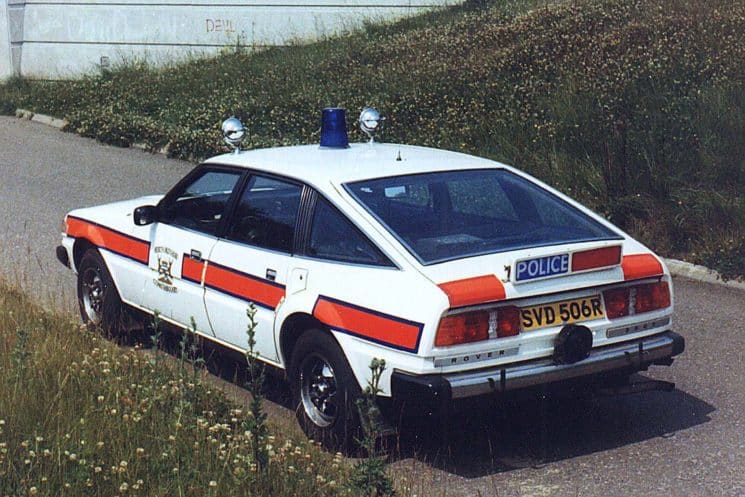

The unmistakable motorway Rover
For many enthusiasts, a Rover SD1 wearing police livery is the defining image of 1980s traffic policing. Its broad stance and distinctive hatchback shape gave it presence, while the V8 versions supplied the performance that made the association so memorable.
Hertfordshire’s archive gives the story a clear starting point in that force: an SD1 demonstrator in 1976, followed by a 1977 car at its Northern Traffic Base. It is a useful documented example of the model’s arrival in traffic work, without imposing one service timeline on every British force.
The SD1 also had a practical advantage that could be overlooked beneath the styling. Its large rear hatch made equipment accessible, and its spacious cabin suited the working needs of a traffic crew. The result was a police car with both character and purpose. Decades later, the combination of Rover V8 and blue lights still has considerable nostalgic power.
1. Jaguar Mk2
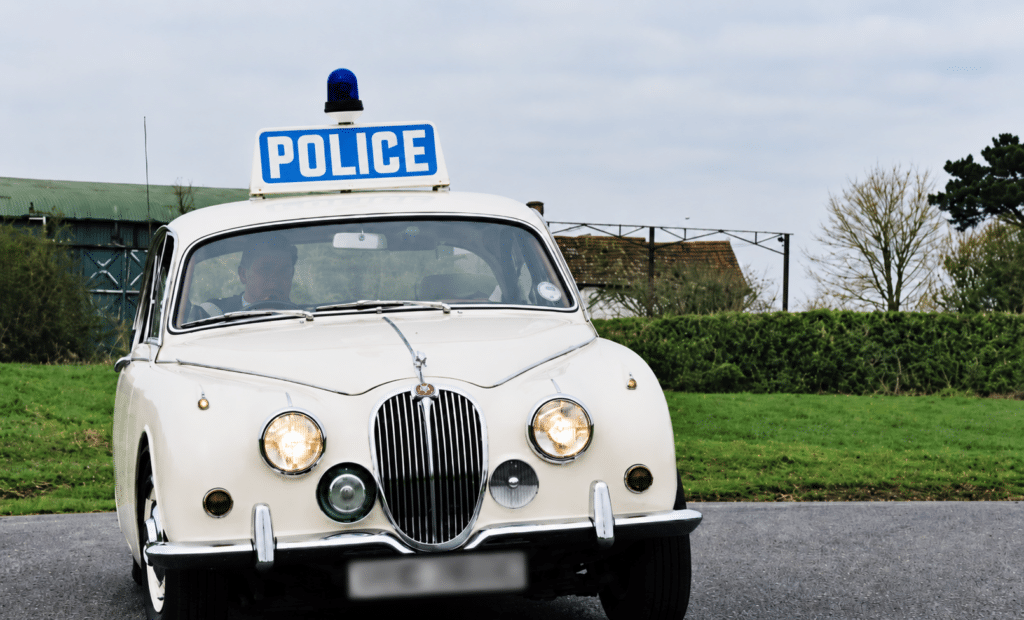

The Jaguar that earns the top spot
The Jaguar Mk2 belongs at the head of this enthusiast’s countdown because it combines performance, presence and one of the strongest visual identities in classic police motoring. Jaguar’s XK straight-six and four-wheel disc brakes helped make the compact saloon a serious proposition for traffic work. Ironically, it was the MK2’s use by the criminal classes that earned the car’s reputation as a getaway car, with enough power, handling and space to whisk the loot away quick smart. It was only natural then that the Police force should employ a fleet of them to keep up, especially when they got to chase on the unrestricted speed limits of the early M1 motorway.
One documented Somerset and Bath Constabulary example, TYC 766G, entered the Traffic Department in November 1968 and was based at Weston-super-Mare. Police Car UK records an unusual detail: its Jaguar Heritage Certificate identifies it as a 240 fitted with a 3.4-litre engine, reflecting a special-order specification for police use.
Together, the Mk2 and its later derivatives capture the appeal of the powerful British police saloon. A period-liveried example has elegance as well as authority, and its reputation has outlasted its working career. We need not call it Britain’s first high-performance police car to recognise why it remains such an enduring favourite..
A working history worth preserving
These cars tell the story of changing police work as much as changing automotive fashion. The Minor and Anglia helped make local patrols mobile, the Triumph and Rover served the motorway era, and the Range Rover brought extra versatility to incident response. The TR4 and XJ-S add the unexpected choices that make motoring history such an enjoyable territory.
What unites them is the work behind the livery. Preserving their histories alongside the classic vehicles allows us to appreciate what they actually did, and makes the sight of a classic police car at a show all the more rewarding.
Thanks to https://policecaruk.co.uk/ which you should visit if you’d like to learn more about heritage Police vehicles!
Protecting a classic of your own?
From much-loved classics to collections of historic vehicles, Peter James Insurance specialises in cover for classic car enthusiasts. Find out more about our classic car insurance or get a quote today.